Turnover and privatization
When a tenant ends their rental contract, the unit becomes vacant, and the lessor can choose to either privatize (sell) the unit or relet it to a new tenant. The turnover rate represents the percentage of tenants who leave, while the privatization rate indicates the percentage of vacant units sold instead of being relet. The relet rate is the difference between the turnover and privatization rates, showing how many units are relet to new tenants. Additionally, lessors can offer the option for current tenants to buy the unit, known as the privatization rate to current lessees. The strategies available include Privatization, which focuses on selling units, and Turnover, which prioritizes re-letting them. If no units are privatized, the turnover rate matches the relet rate.
The Turnover & Privatization screen allows you to view the turnover and privatization rates and enter assumptions about the future of indefinite period rental contracts. To access this screen:
1. Go to the Asset details page of the asset/property you wish to view or edit.
2. In the navigation panel, select Input > Turnover & Privatization. The following screen appears:
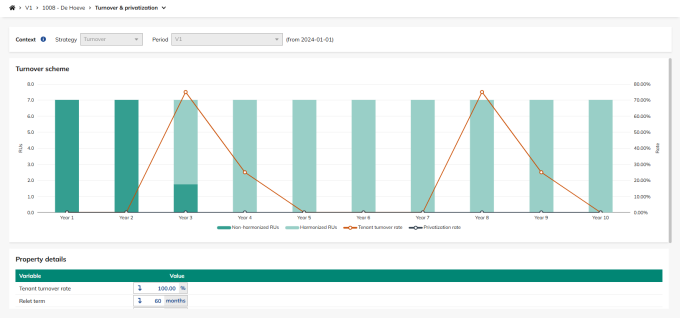
 | This screen is only accessible if the property has at least one indefinite period rental contract. It has two versions, depending on the selected strategy: Turnover or Privatization. |
The Turnover & Privatization screen is divided into three sections:
1. Turnover scheme
This section visually presents both the input and calculated output at the top of the screen. The data updates when switching between strategies. It shows the number of contracts already harmonized versus those that still need to be harmonized.
The line graph displays the actual tenant turnover rate and privatization rate. If a rentable unit is vacant at the start of the forecast, it remains vacant during the vacancy period and is then rented out during the mandatory relet period (for example, 12 months). As a result, in the first year of the forecast, the unit is not turned over, and the tenant turnover rate is zero.
The graph in the Turnover & Privatization screen shows the calculated tenant turnover rate at the property level. If a property has vacant rentable units, the calculated rate in the graph may differ from the input tenant turnover rate. After one year, the effect of initial vacancy is balanced out, and the input and calculated turnover rates align again.
2. Property details
This section helps you enter the necessary information for the turnover and privatization scheme. The following fields are available (depending on the selected strategy):
◦ Tenant turnover rate
The default tenant turnover rate per forecast year applied to indefinite-period contracts that can be terminated by the lessee. This field populates the tenant turnover rate for each forecast year if no manual input is provided.
◦ Relet term
The minimum lease term, expressed in months, for an indefinite-period contract after which the lessee can terminate the contract.
◦ Vacancy term
The number of months it takes to relet a rentable unit once it becomes vacant.
◦ Rent-free term
The number of months a lessor offers a rent-free period as an incentive for a potential lessee to rent a unit at the estimated rental value.
◦ % RUs with privatization restrictions
Calculates the number of active rentable units (RUs) on the reference date that have an end-date privatization restriction, divided by the total number of active RUs on the reference date.
◦ Discount current lessees (% VPV)
The discount percentage applied to reduce the indexed vacant possession value on the privatization date.
◦ Direct privatization of vacancy
If set to Yes, vacant rentable units as of the process reference date are sold at the vacant possession value on the forecast start date. Units with privatization restrictions are not sold.
◦ Privatization term
The duration, in months, that a vacant rentable unit is listed on the market before being sold. This term is ignored for privatization to current lessees, where the unit is sold immediately.
3. Turnover & privatization rates
In this section, you can enter assumptions related to:
◦ Tenant turnover rates
This rate reflects the portion of indefinite-period contracts per forecast year that can be terminated by the lessee.
◦ Privatization rates
This rate reflects the portion of indefinite-period contracts per forecast year that will turn over and become available for sale to third parties.
◦ Privatization rate current lessees
This rate reflects the portion of indefinite-period contracts per forecast year that will be sold to current lessees.