Domain settings
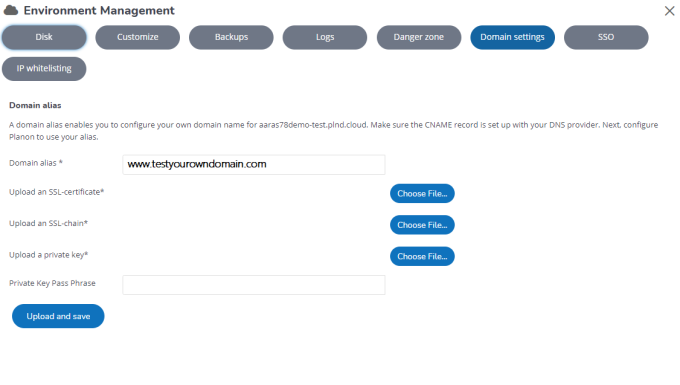
On this tab you can configure your own domain aliasing for your individual Planon instances.
 | • Only one domain alias is allowed at a time. Adding another will delete the current one. • When SSO is enabled in your environment, please make sure to first follow the instructions for enabling the Privacy Sandbox compatibility before enabling the Custom Domain. • When using Planon IoT, IoT must be disabled and re-enabled after changing or removing a domain alias. Planon IoT will then be able to correctly reestabilsh a connection. |
 | • When SSO is enabled in your environment, please modify the configuration in the Identity Broker Solution to allow the new to be configured Custom Domain URL as a valid redirect URL in the Planon Client. For more information, see Custom domain allowance (Authentication Methods). • If you enable a custom domain, the Self-Service (PSS) Site URL that is configured when adding a site, will automatically be updated with the correct custom domain when implementing the Cloud configuration steps. |
Procedure
1. In the Domain alias field, enter the domain alias name that you want to configure.
2. Choose files and upload SSL certificate, SSL chain and Private key (for this Domain).
3. Finally save the domain settings.
A message is displayed when the domain alias is set successfully.
Certificate requirements
• Certificate files must be Base64 PEM-encoded and typically have a .crt or .pem extension.
Example certificate.pem
-----BEGIN CERTIFICATE-----
MIIHgjCCBeqgAwIBAgIRAMSo3jNZHQSEnRRh61MB2O4wDQYJKoZIhvcNAQELBQAw
YDELMAkGA1UEBhMCR0IxGDAWBgNVBAoTD1NlY3RpZ28gTGltaXRlZDE3MDUGA1UE
AxMuU2VjdGlnbyBQdWJsaWMgU2VydmVyIEF1dGhlbnRpY2F0aW9uIENBIERWIFIz
-----END CERTIFICATE-----
MIIHgjCCBeqgAwIBAgIRAMSo3jNZHQSEnRRh61MB2O4wDQYJKoZIhvcNAQELBQAw
YDELMAkGA1UEBhMCR0IxGDAWBgNVBAoTD1NlY3RpZ28gTGltaXRlZDE3MDUGA1UE
AxMuU2VjdGlnbyBQdWJsaWMgU2VydmVyIEF1dGhlbnRpY2F0aW9uIENBIERWIFIz
-----END CERTIFICATE-----
• Chain file must be Base64 PEM-encoded and doesn’t need to include the domain certificate or root. Only the intermediates are required.
Example chain.pem
-----BEGIN CERTIFICATE-----
MIIGTDCCBDSgAwIBAgIQOXpmzCdWNi4NqofKbqvjsTANBgkqhkiG9w0BAQwFADBf
MQswCQYDVQQGEwJHQjEYMBYGA1UEChMPU2VjdGlnbyBMaW1pdGVkMTYwNAYDVQQD
Ey1TZWN0aWdvIFB1YmxpYyBTZXJ2ZXIgQXV0aGVudGljYXRpb24gUm9vdCBSNDYw
-----END CERTIFICATE-----
-----BEGIN CERTIFICATE-----
MIIGlTCCBH2gAwIBAgIRANJ/u8HeNZ5SFq1hSVhgmcQwDQYJKoZIhvcNAQEMBQAw
gYgxCzAJBgNVBAYTAlVTMRMwEQYDVQQIEwpOZXcgSmVyc2V5MRQwEgYDVQQHEwtK
ZXJzZXkgQ2l0eTEeMBwGA1UEChMVVGhlIFVTRVJUUlVTVCBOZXR3b3JrMS4wLAYD
-----END CERTIFICATE-----
MIIGTDCCBDSgAwIBAgIQOXpmzCdWNi4NqofKbqvjsTANBgkqhkiG9w0BAQwFADBf
MQswCQYDVQQGEwJHQjEYMBYGA1UEChMPU2VjdGlnbyBMaW1pdGVkMTYwNAYDVQQD
Ey1TZWN0aWdvIFB1YmxpYyBTZXJ2ZXIgQXV0aGVudGljYXRpb24gUm9vdCBSNDYw
-----END CERTIFICATE-----
-----BEGIN CERTIFICATE-----
MIIGlTCCBH2gAwIBAgIRANJ/u8HeNZ5SFq1hSVhgmcQwDQYJKoZIhvcNAQEMBQAw
gYgxCzAJBgNVBAYTAlVTMRMwEQYDVQQIEwpOZXcgSmVyc2V5MRQwEgYDVQQHEwtK
ZXJzZXkgQ2l0eTEeMBwGA1UEChMVVGhlIFVTRVJUUlVTVCBOZXR3b3JrMS4wLAYD
-----END CERTIFICATE-----
• Private key file must be Base64 PEM-encoded.
Example private_key.pem
-----BEGIN PRIVATE KEY-----
MIIJQQIBADANBgkqhkiG9w0BAQEFAASCCSswggknAgEAAoICAQCydEOx9cr/qN4J
Zsv92l3U+FTYimkcFcogWwF7Nd3I73eji9/MU6nfIuVQOSJbZMhOvtWiEFXM8Q6j
DHkAoA5SSbopnZE319jl/pFqoKTSokJwRwHsospGnLk3Nv5VK3q4Wa7ME7V5LqrD
-----END PRIVATE KEY-----
MIIJQQIBADANBgkqhkiG9w0BAQEFAASCCSswggknAgEAAoICAQCydEOx9cr/qN4J
Zsv92l3U+FTYimkcFcogWwF7Nd3I73eji9/MU6nfIuVQOSJbZMhOvtWiEFXM8Q6j
DHkAoA5SSbopnZE319jl/pFqoKTSokJwRwHsospGnLk3Nv5VK3q4Wa7ME7V5LqrD
-----END PRIVATE KEY-----
• Other certificate and/or private key formats will not be loaded and will return an error message.
DNS administration
Finally, the customer's DNS administrator needs to create a reference to the original Planon URL via a CNAME record (DNS alias). Also, the DNS administrator is responsible for maintaining this certificate.