Micro frontend settings
To enable more flexible, micro frontend–specific configuration, the concept of Micro frontend settings has been introduced.
Micro frontend settings are configuration fields that are explicitly exposed by a micro frontend and defined by its developer. These settings allow application managers to influence the behavior of a micro frontend without changing the underlying implementation.
Conceptual model
For each micro frontend, configuration is structured across multiple levels:
• A micro frontend definition describes the capabilities of the micro frontend, including which settings can be configured.
• A settings schema is stored on the micro frontend definition and defines the available settings, their data types, and special behavior.
• A micro frontend user definition represents a specific instance of the micro frontend and contains the actual values configured for those settings.
The settings schema determines what can be configured. The settings on the micro frontend user definition determine how the micro frontend behaves in a specific context.
Visibility and scope
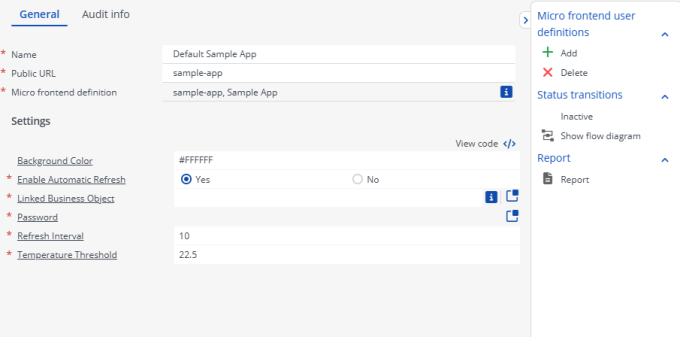
Micro frontend settings are configured at the level of Micro frontend user definitions, on the General tab.
Only settings that are defined in the settings schema of the associated micro frontend definition are shown. Which settings are available is therefore fully determined by the micro frontend itself and depends on the implementation provided by the developer.
When a setting is changed in Micro frontend manager, the updated value becomes available to the micro frontend the next time it is loaded. If the micro frontend is already open, a manual page refresh (F5) is required. There is no automatic refresh of the micro frontend when settings are changed.
Settings schema
When a micro frontend user definition is created or edited, it reads the settings schema from the associated micro frontend definition. User-specific configuration values are then applied on top of this schema. The combination of the Settings schema and the configured settings determines which fields are shown on the Micro frontend user definitions level and how they behave.
Special setting types
Some setting types have specific behavior:
• Business Object–linked settings
A setting can be linked to a business object. Which business objects can be linked is defined by the micro frontend and therefore depends on the implementation provided by the developer.
• Password settings
Password settings are treated as secret fields. Their values are stored in encrypted form. The micro frontend does not receive the plain-text value, but only the secured representation of the password.